

When Health Equity International (HEI) in southern Haiti was selected as a MedMissions awardee in 2025, the vision was clear: equip frontline clinicians with point-of-care ultrasound (POCUS) skills and tools to make faster, more accurate decisions for patients in some of the most challenging conditions in the world.
From the start, the project aimed to do more than introduce a new device. Together, HEI and the Inteleos Foundation set out to build lasting diagnostic capacity by training Haitian physicians, standardizing curriculum, and integrating handheld ultrasound into routine care in emergency and maternal health settings.
Training Haitian Clinicians as POCUS Leaders
The project launched on April 1, 2025, with a cohort of five clinicians from emergency medicine, obstetrics, family medicine, and ultrasound technology at St. Boniface Hospital. All five completed the POCUS Fundamentals Certification through the POCUS Certification Academy, validating their core competencies in ultrasound and laying the foundation for a local training hub.
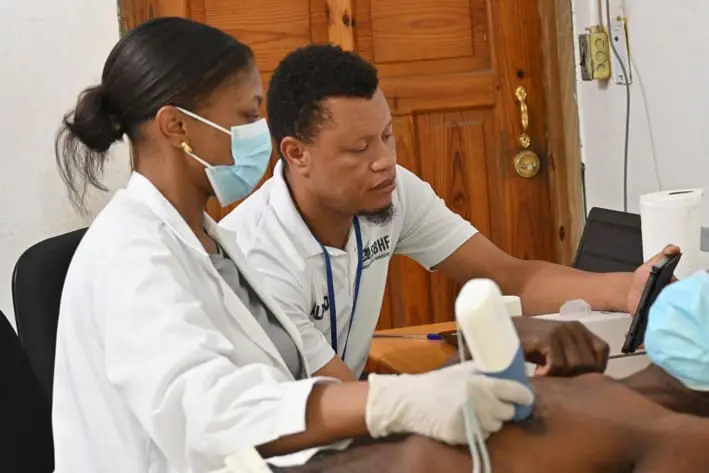
Throughout the year, the team participated in regular working sessions, hands-on practice, and remote technical exchanges with volunteer advisors. These collaborations supported curriculum development, troubleshooting, and best-practice sharing as clinicians began using Vave handheld probes for abdominal, cardiac, and obstetric assessments in emergency, maternity, and general medicine departments.
A major milestone came with the completion and adoption of a comprehensive ultrasound training curriculum and field guide. This six-month, blended program—delivered through in-person workshops and tele-mentorship—covers maternal and obstetric care, gynecology, trauma and emergency POCUS, cardiac ultrasound, abdominal imaging, and neonatal and general medicine, all tailored to low-resource clinical realities.
Impact That Outlasts the Project Year
While the project faced challenges throughout the year, the most meaningful impact lies in the capacity that has been built. Over the course of the year, clinicians performed 23 handheld ultrasound procedures on 7 patients using Vave devices, with high impact on clinical decision-making, with an estimated 81–100% of scans changing patient management.
At the same time, HEI and St. Boniface Hospital now have:
- Five clinicians certified in POCUS Fundamentals, forming a core group of trained providers
- A finalized, HEI-owned curriculum and field guide that will support future cohorts of trainees
- A selected pair of clinicians preparing to field-test the curriculum in February 2026 and move toward advanced certification as local trainers
These achievements mean the work of MedMissions is already extending beyond the award year as HEI continues to refine protocols, strengthen documentation, and expand ultrasound capability across departments.
Navigating Device and Systems Challenges
Progress did not come without obstacles. From the outset, the team faced operational and contextual challenges typical of rural, disaster-affected, and politically unstable environments.
Political instability complicated implementation by preventing Boston-based team members from providing on-site support, slowing workflow coordination and troubleshooting. Despite these barriers, HEI clinicians persisted, progressively incorporating handheld ultrasound alongside conventional machines, refining cooling protocols, and working closely with advisors to improve utilization.
Partnership Beyond the Grant Period
As the formal MedMissions award year closes, the partnership between HEI and the Inteleos Foundation is moving into a new phase rather than ending. Together, the teams have outlined several ongoing areas of collaboration:
- Advanced POCUS certification for two HEI physicians who will become local trainers in maternal and emergency ultrasound
- Continued remote mentorship from technical advisors to support curriculum refinement, clinical integration, and the upcoming field test
- Exploration of access to refurbished ultrasound devices and additional batteries through U.S. hospital partners and industry collaboration
- Joint funding exploration to scale POCUS training and integration to other departments and facilities in Haiti’s southern peninsula
These commitments reflect a shared focus on sustainability: building Haitian-led expertise, strengthening systems, and positioning handheld ultrasound as a durable component of patient care at St. Boniface Hospital.
Looking Ahead: From Pilot to Practice
HEI’s MedMissions project has laid a strong foundation for ongoing POCUS capacity strengthening in a rural, disaster-affected setting. The combination of certified trainers, a competency-based curriculum aligned with global standards, and continued mentorship provides momentum for deeper clinical integration in the years ahead.
In the next phase, HEI will continue integrating handheld ultrasound into workflows across emergency, maternity, and general medicine, while preparing the first training cohort to use the finalized curriculum and field guide. With each scan, each supervised training, and each iterative improvement, the team is bringing high-quality diagnostic imaging closer to the patients who need it most.
If your organization is interested in partnering to expand POCUS training, support device access, or co-fund future MedMissions projects, we invite you to connect with Sam Forcum ([email protected]) to explore what’s possible.